Create printable spelling tests in 6 formats. Enter your words, pick a format, download a PDF. No sign-up.
Designed for different grade levels and skills. Find the perfect format for your weekly spelling test.
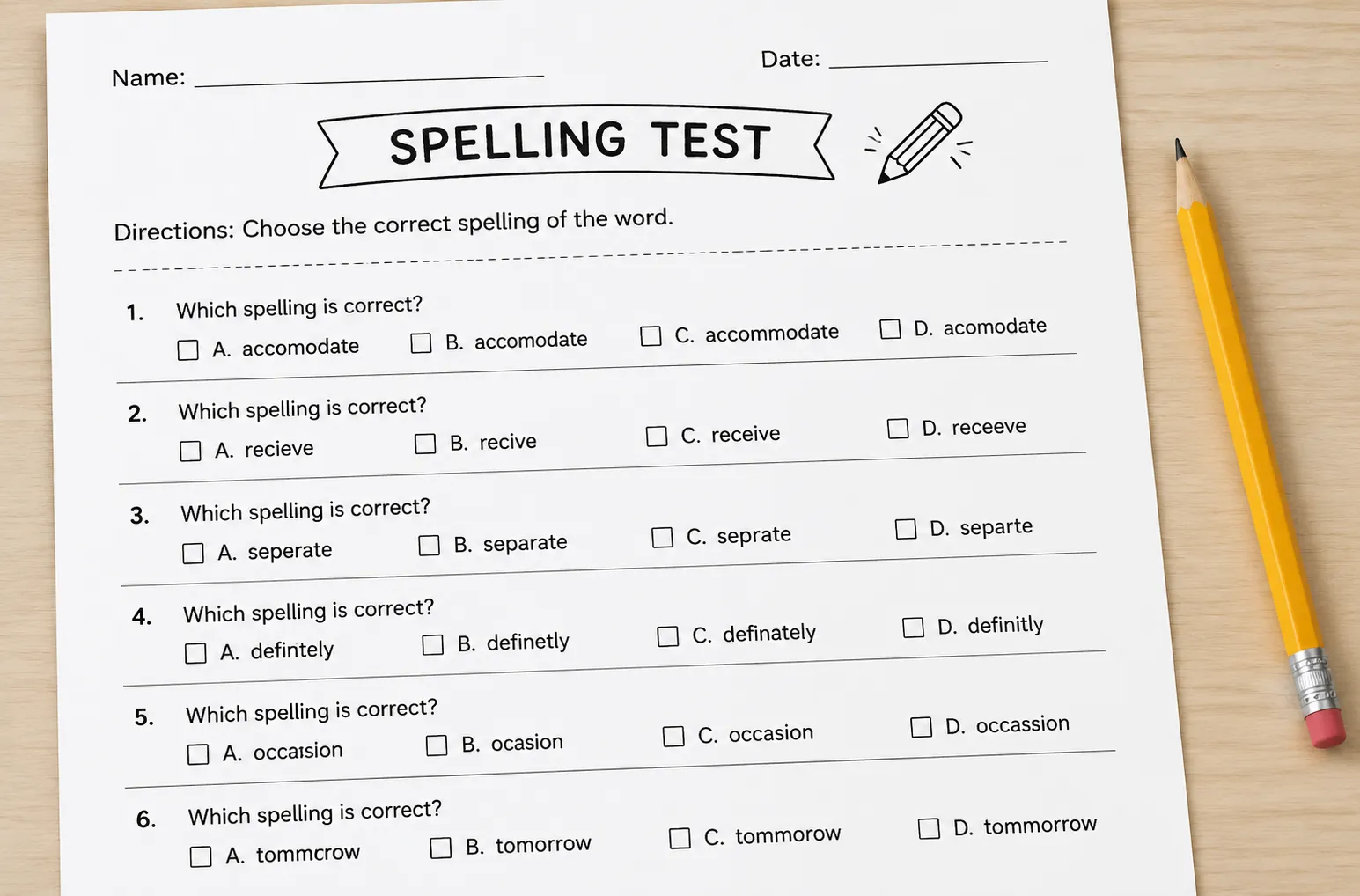
Generate a classic multiple choice spelling test generator format with 1 correct word and 3 distractors.
Learning objective: Builds word recognition and discrimination skills by identifying correct spelling among common misspellings.
Try this format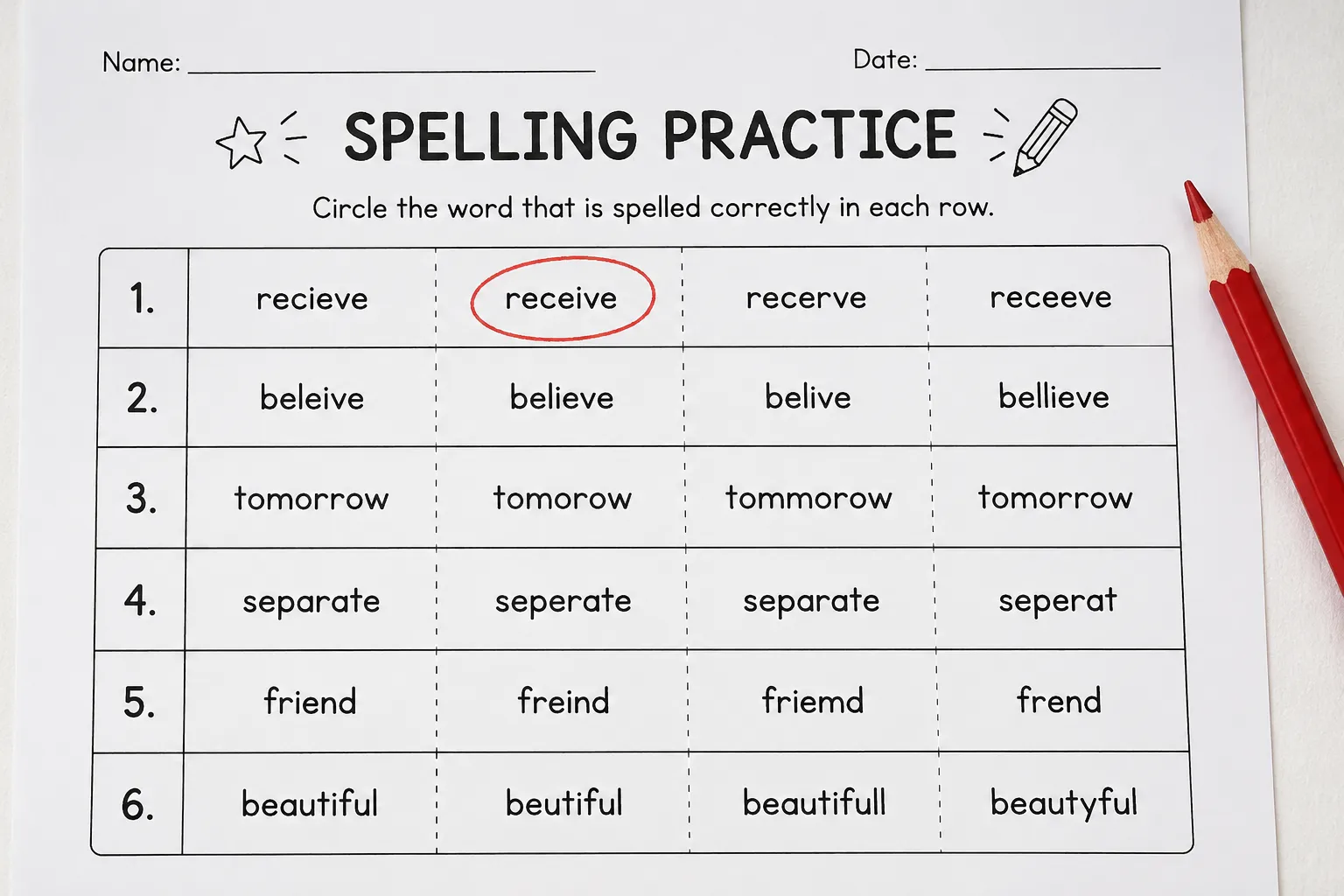
Create a spelling test generator circle the correct word layout, presenting 3-4 options per line.
Learning objective: Develops visual pattern recognition for K-2 learners who can identify but cannot yet reliably produce correct spelling.
Try this format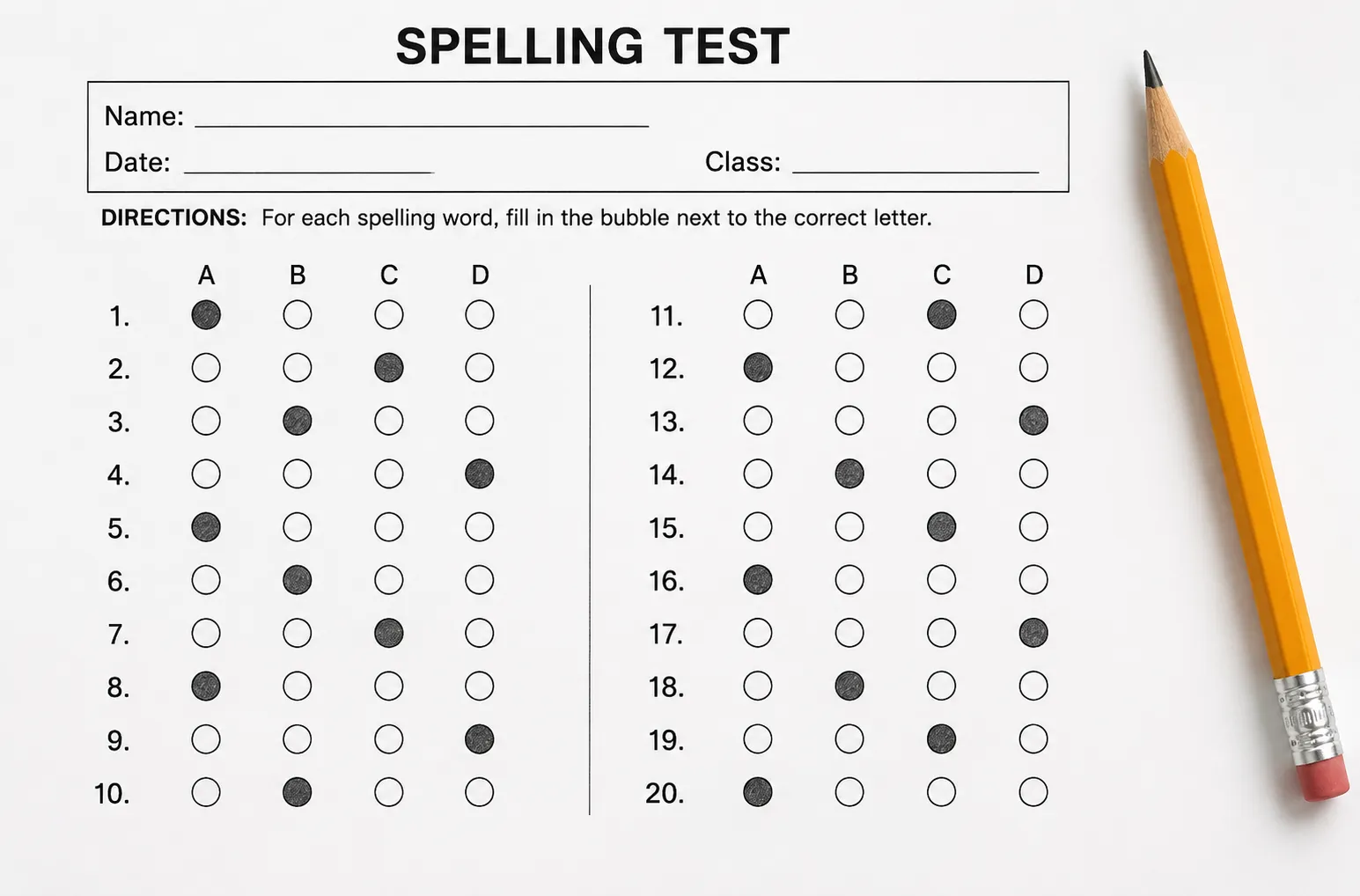
Our unique bubble spelling test generator format is perfect for early writers who find filling bubbles easier than writing.
Learning objective: Removes handwriting load so emerging writers can focus purely on spelling choice—also builds bubble-sheet familiarity for state testing.
Try this format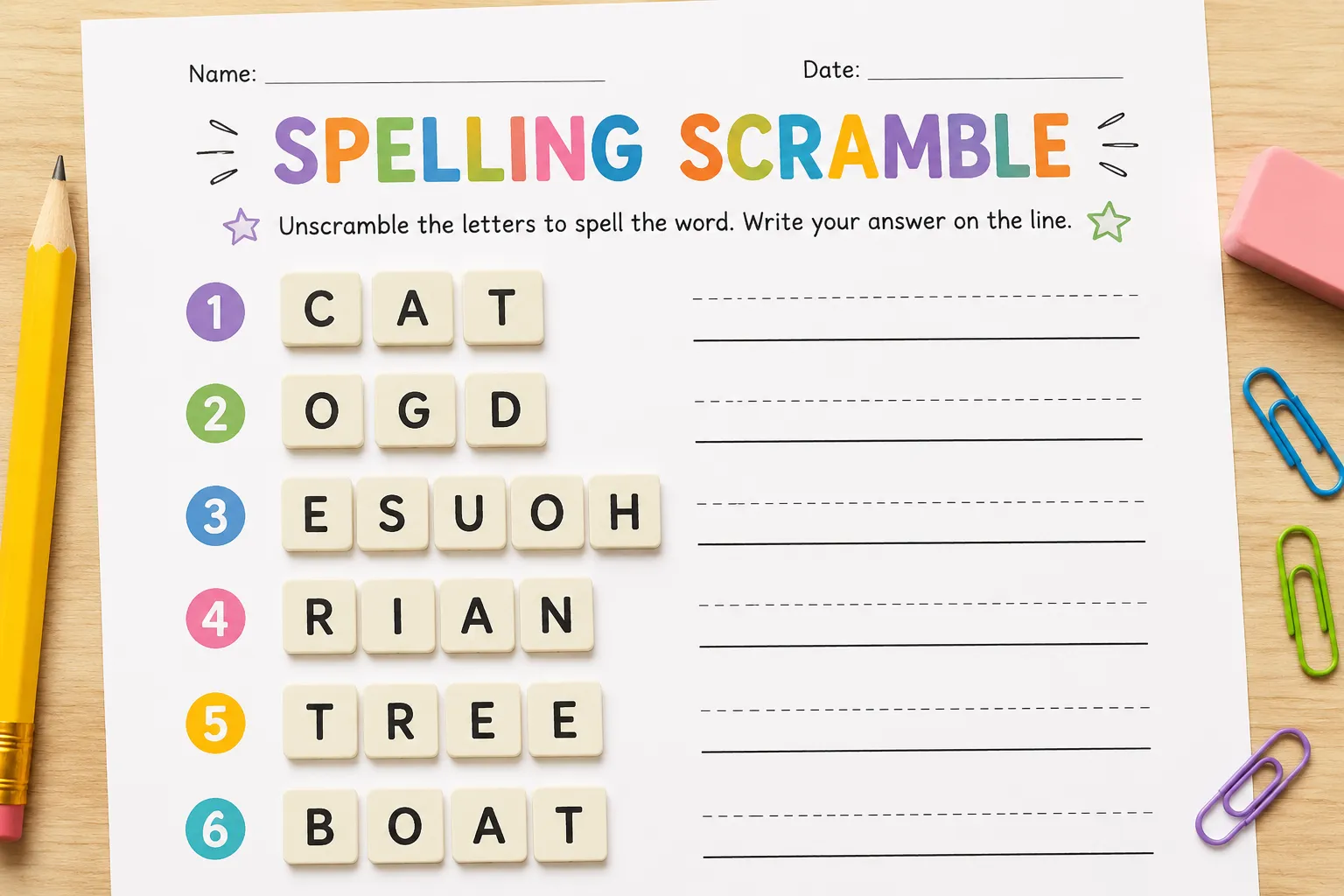
The spelling test generator scrambled letters format automatically mixes up letters to challenge word recognition.
Learning objective: Trains letter-sequence awareness and orthographic mapping—students must reconstruct the word from memory, not just recognize it.
Try this format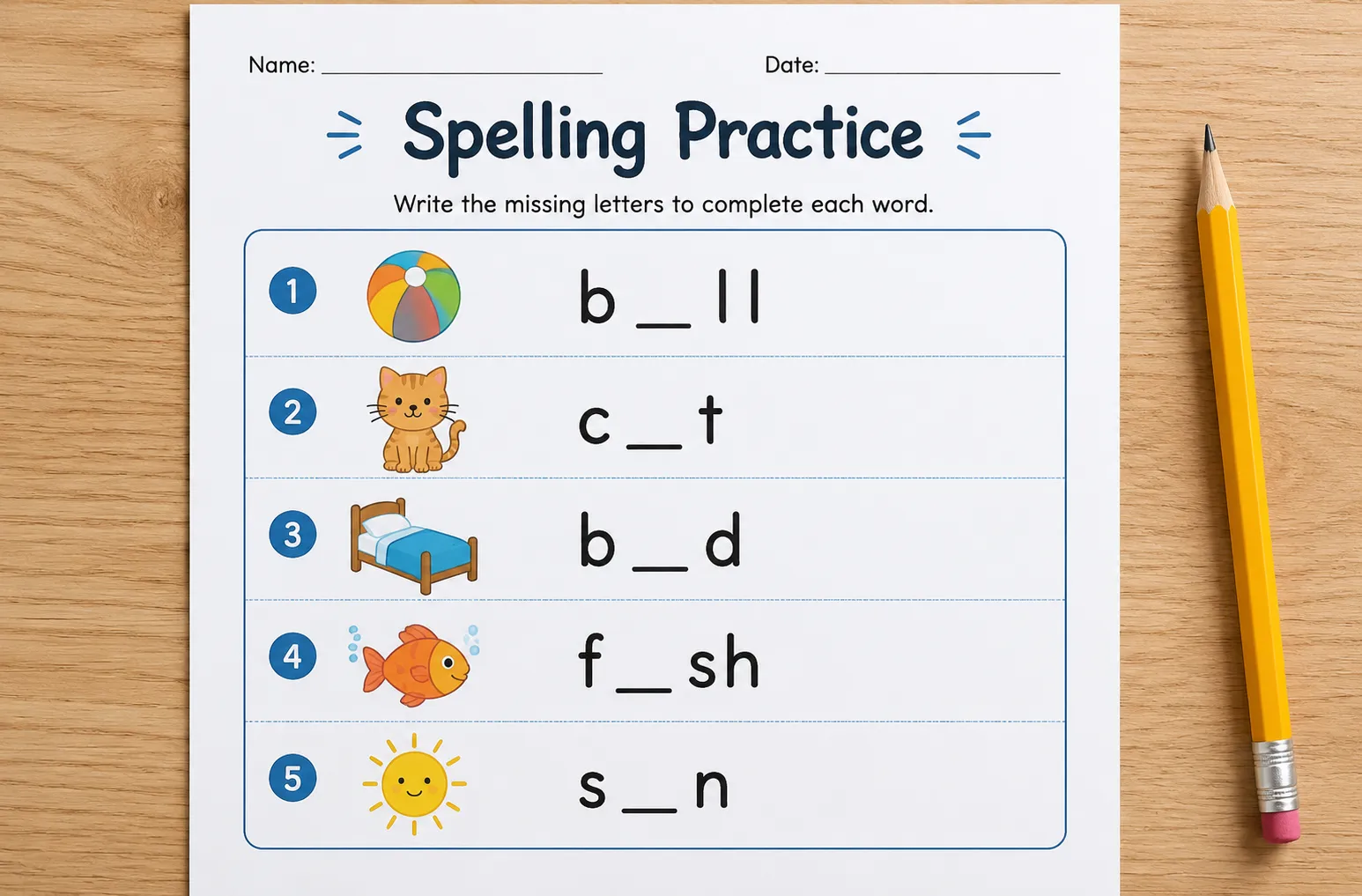
Use the spelling test generator missing letter format to automatically blank out 1-2 letters per word.
Learning objective: Isolates phonics patterns—great for targeting tricky vowels, silent letters, or blends/digraphs that students consistently miss.
Try this format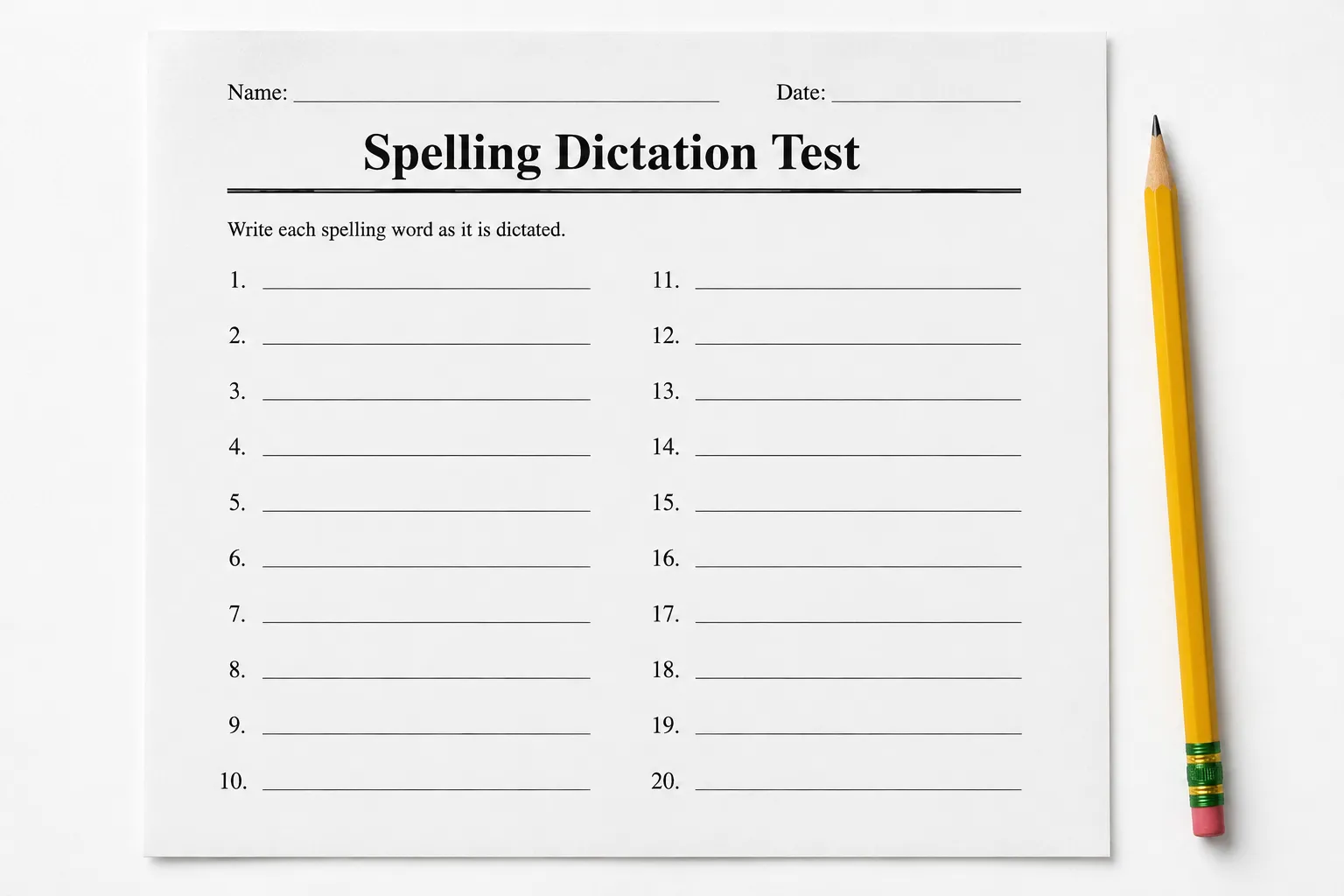
A classic numbered line layout. If you're looking for a printable alternative to a spelling test generator with audio, this is it.
Learning objective: Tests true spelling recall under teacher-led dictation—the gold standard for weekly summative spelling assessment.
Try this formatDon't want to type words? Load our built-in lists instantly.
Pre-K / K / 1st / 2nd / 3rd
First 100 / Second 100 / Third 100
Categorized by a/e/i/o/u vowels
Curated for 1st-5th Grade
bl/cl/fl, ch/sh/th, and more
Type, paste, or load a pre-made list into the generator.
Choose from 6 formats for different grade levels and skills.
Instantly get your free, print-ready PDF. No sign-up required.
Generate weekly spelling tests without manual formatting in Word or Docs.
Create custom tests perfectly aligned with your unique curriculum.
Design vocabulary tests tailored specifically for English learners.
Build practice tests using our scramble and missing letter formats.
Utilize large font options and bubble formats for better accessibility.
Get ready-to-print tests instantly when you need them fast.
Most tools only offer 1 or 2. We give you variety for every learning style.
Skip the login walls. Generate your test immediately.
Designed specifically for the physical classroom, not just online screens.
Access hundreds of sight words and grade-level vocabulary instantly.
Our core generation features will always be free to use.
Layouts crafted based on real classroom needs and pedagogy.
Each format trains a different cognitive skill. Use this guide to pick the right one for each grade level, each assessment goal, and each point in your weekly spelling routine.
What it trains: Word-level recognition. Students see the correct word alongside 3 plausible misspellings ("recieve / receive / receeve / receve") and pick the right one.
When to use: Mid-week formative check, or for students with handwriting difficulties who need a recognition-based assessment. It surfaces students who can read the word but haven't yet locked in the spelling.
Watch out for: Strong test-takers can guess. Pair with a Dictation test the next day to confirm true mastery.
What it trains: Visual pattern recognition without the writing load. Students see 3-4 versions of each word and circle the correctly spelled one.
When to use: Early elementary, ESL beginners, or any student whose spelling knowledge outpaces their fine motor skill. Ideal for the first quarter of kindergarten when handwriting is still emerging.
Watch out for: Use no more than 4 options per line—more than that overloads working memory for young readers.
What it trains: Spelling discrimination plus bubble-sheet fluency. Filling bubbles is physically easier than writing letters, so the score reflects spelling knowledge rather than penmanship.
When to use: K-1 weekly tests, special education accommodations, and grades 3-5 in the weeks leading up to state standardized testing (where bubble familiarity matters).
Watch out for: Print at "actual size"—shrinking the PDF makes bubbles too small to fill cleanly.
What it trains: Orthographic mapping—the mental skill of knowing which letter sequences are legal English. Students must reconstruct the word from scratch, not just recognize it.
When to use: Spelling Bee preparation, vocabulary review weeks, or as a challenge format for students who breeze through Multiple Choice. Particularly effective for words with unusual letter combinations (rhythm, neighbor, eighth).
Watch out for: Pair with the answer key on a separate page—students will ask for hints, and you'll want the answers handy without giving them away.
What it trains: Specific phonics patterns. Blank a vowel ("b_g") and you're testing short-vowel discrimination. Blank a consonant blend ("_ip") and you're testing onset recognition. Blank a silent letter ("kn_w") and you're testing irregular spelling memory.
When to use: After teaching a specific phonics rule. If your week's lesson covered the "magic e" pattern, generate a Missing Letter test that blanks the final e on all 15 words.
Watch out for: Our tool auto-prioritizes blanking vowels, which works for grades K-2. For older students, you'll want to manually edit a few words to blank consonants instead.
What it trains: True spelling recall under live conditions. The student hears the word, holds it in working memory, and writes it from scratch—the gold-standard measure of spelling mastery.
When to use: Every Friday, every grade. This is the format that goes home in the report card. Use the other five formats during the week to build up to it.
Watch out for: Read each word three times: word, sentence, word. Pause 8-10 seconds. Younger students need the full pause; rushing this format inflates error rates without measuring actual spelling skill.
A typical weekly routine: Mon Circle the Word (intro) → Tue Missing Letter (phonics) → Wed Scrambled (challenge) → Thu Multiple Choice (review) → Fri Dictation (summative).